
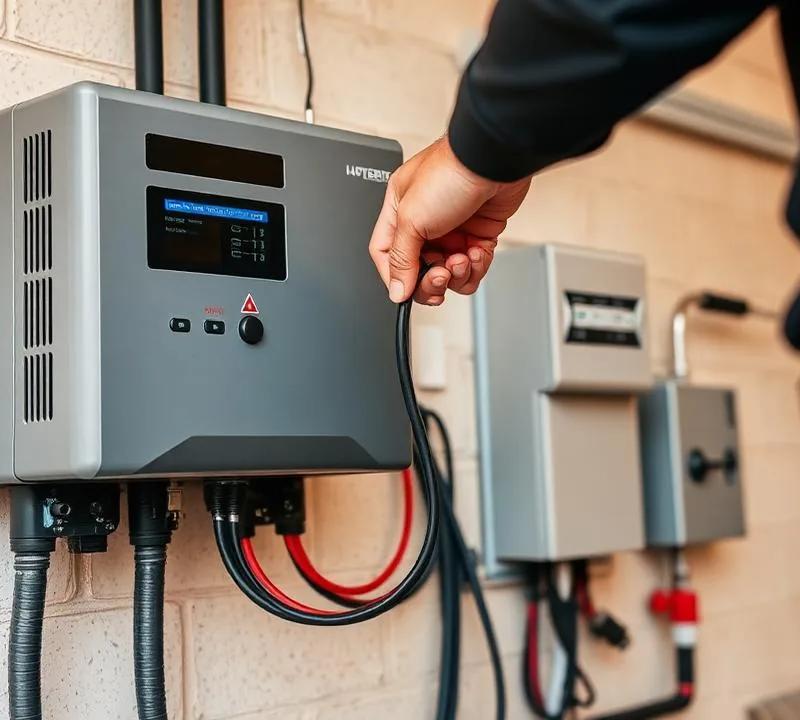
The installer asks: "standard inverter or hybrid?". A customer who isn't planning a battery storage system anytime soon reflexively picks the cheaper option. The problem shows up two years later, when storage prices drop and the Przydomowe Magazyny Energii (Home Energy Storage) grant — up to PLN 28,000 — becomes tempting, only to discover a second inverter is now needed.
What's the difference
A string (on-grid) inverter converts DC from the panels into AC and feeds it to the grid or the house. It has no battery DC input and no backup port.
A hybrid inverter has an extra DC input for a battery and usually a backup/EPS (Emergency Power Supply) port that, during a grid outage, disconnects the system and powers selected circuits from the battery. In practice a hybrid combines an inverter, battery charge controller and switching automation in one box. It's worth remembering that buying a hybrid inverter doesn't automatically mean backup — the EPS function is sometimes a paid extra with some manufacturers, and has to be ordered deliberately.
Premium today vs retrofit cost
| Scenario | Cost today | Cost in 2 years (if storage is needed) | Total cost |
|---|---|---|---|
| String inverter, never adding storage | PLN 8,000-12,000 (inverter only) | — | PLN 8,000-12,000 |
| Hybrid inverter now, battery added later | PLN 10,000-15,000 | battery only: PLN 10,000-18,000 | PLN 20,000-33,000 |
| String inverter now, AC-coupled retrofit in 2 years | PLN 8,000-12,000 | extra AC-coupled inverter PLN 5,000-8,000 + installation work PLN 1,500-3,000 + re-notification to the grid operator (fee + ~30-day wait) | PLN 14,500-23,000 + lost time |
Retrofitting works, but AC-coupling adds a second inverter in parallel with the existing one, lowering overall system efficiency by a few percent and complicating service — two devices, two warranties, two manufacturers to deal with in case of a fault.
When a standard inverter is enough
If the budget is tight, the roof has modest capacity (up to 4-5 kWp), and the owner is fairly certain they won't add storage or backup — because outages in the area are rare and self-consumption is already high thanks to correctly sized capacity — a string inverter is fine. It's also an honest choice for the smallest budgets, where cost per kWp matters most.
Three-phase backup: what to check
In homes with a heat pump or three-phase supply, a backup port alone isn't enough — check:
Prepare the installation even without storage yet
Even choosing a standard inverter, it's worth doing upfront:
That's a cost of a few hundred zloty during installation, saving thousands later.
Compatibility and vendor lock-in
Not every battery fits every hybrid inverter — manufacturers often require their own battery (dedicated CAN/RS485 communication), and mixing brands voids the system warranty. Before buying a hybrid inverter, check the manufacturer's compatible battery list and whether the range includes a battery meeting the requirements of the Home Energy Storage grant — it requires, among other things, island-mode capability and integration with an energy management system (EMS).
Warranty and service in practice
A hybrid inverter is a more complex piece of electronics than a string unit, so before buying it's worth comparing not just the price, but also warranty length (typically 5-10 years, with some manufacturers offering a paid extension to 15-20 years) and local service response time. One device instead of two (a string inverter plus a separate AC-coupled unit added at retrofit) also means a single point of contact for faults and simpler remote diagnostics — most hybrids report battery and backup status in the same app as PV production, which makes catching a fault faster.
Financing: tax relief and grant schedule
An inverter purchase, regardless of type, can be settled under the PIT thermomodernization tax relief — a deduction from income of up to PLN 53,000 per person (PLN 106,000 for a couple filing jointly), provided you have VAT invoices and complete the investment within 3 years. If the plan also includes a battery, keep an eye on the Przydomowe Magazyny Energii application windows — they can be short (a matter of days) and require documentation prepared in advance. Check the current subsidy schedule and a savings simulation on our financing page.
Bottom line
A hybrid inverter makes sense if storage or backup will arrive within 2-3 years — the PLN 2,000-5,000 premium is cheaper than a later retrofit. If plans are distant or uncertain, a standard inverter plus prepared infrastructure is a sensible compromise. Base the decision on a concrete consumption simulation — check the variants in the calculator or compare photovoltaic offers with and without storage.
Common mistakes when choosing
In installation practice, three mistakes repeat: choosing a hybrid inverter without checking available connection capacity for backup, ignoring cooling needs in the technical room (hybrids working with a battery generate more heat than a plain string unit), and skipping a conversation with the grid operator before notifying a microinstallation with island-mode capability. Each mistake is fixable, but it's cheaper to avoid them at the design stage than to correct them after installation.