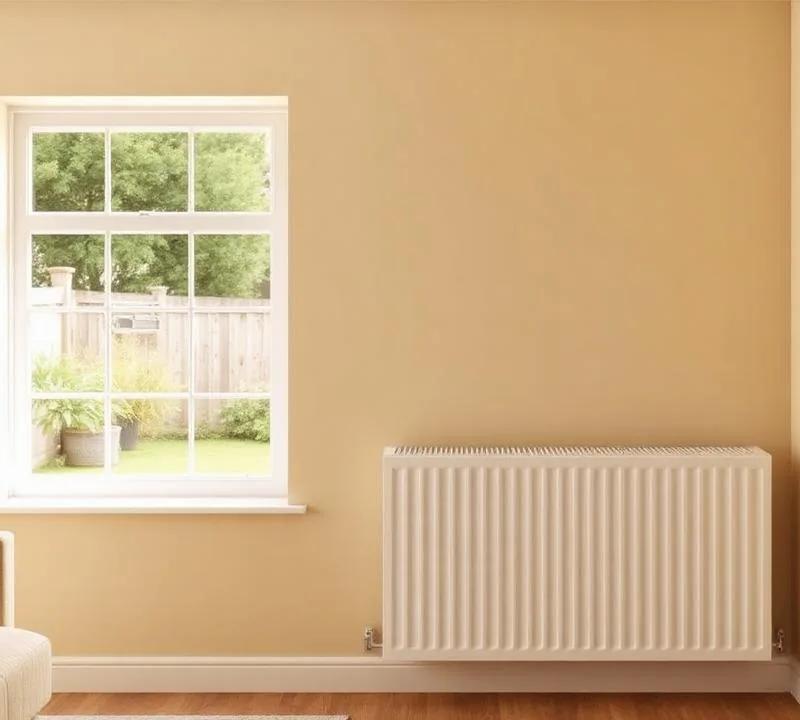
The most common worry when replacing a boiler with a heat pump in a home with radiators is: "the pump heats water to a lower temperature, so the radiators won't cope." That's only partly true — what matters is how oversized the radiators are relative to the building's heat loss, not simply the fact that there's no underfloor heating.
Flow temperature and COP
A heat pump's efficiency (COP — coefficient of performance) drops as flow temperature rises, because the compressor has to do more work to "lift" heat from air or ground to a higher level. Approximate values for an air-source pump at an outdoor temperature of about 2°C:
| Flow temperature | COP (approx.) |
|---|---|
| 35°C | 4.0-4.5 |
| 45°C | 3.2-3.6 |
| 55°C | 2.4-2.8 |
| 65°C | 1.8-2.2 |
The difference between 35°C and 55°C is often a 40% drop in efficiency. So the design goal is to keep flow temperature as low as possible — ideally below 50°C, and around 40-45°C for most of the season.
When existing radiators are enough
Cast-iron radiators from the 1980s-90s, and many panel radiators installed "with a margin," are often oversized relative to the building's actual heat loss — especially if the home was insulated (wall insulation, new windows) after the radiators were installed and they were never resized. In that case a radiator originally sized for 70/55°C flow may still deliver enough heat at 45-50°C, because the building's demand has dropped.
Rule of thumb: if the home is well insulated (losses around 40-60 W/m²) and the radiators were originally sized for an older insulation standard, chances are good you can run at low flow temperature without replacing radiators. It's also worth checking the numbers per room: a type-22 panel radiator measuring 60x120 cm delivers noticeably less power at 45°C than at 70°C — the gap can reach 45-50% — so the "enough or not" decision has to be made room by room, not for the whole house at once.
The 55°C test on a freezing day
The simplest check without calculations: on the coldest available day (close to the region's design temperature, usually -16 to -20°C), set the boiler to a fixed flow temperature of 55°C and see if the home holds a comfortable temperature (21-22°C) after several hours. If it does, that's a good sign the heat pump will manage with the same radiator system for most of the season, aside from extreme days when an electric backup heater tops it up. It's worth repeating this test on a few days with different outdoor temperatures and noting how long it takes rooms to stabilize — that helps design the heating curve.
Calculating demand
A more precise method is calculating heat demand in W/m² or the seasonal EUco (annual useful energy demand for heating, kWh/m²/year) from an energy audit or a simplified index method. Homes before thermal modernization typically show 80-120 W/m², after insulation 40-70 W/m², and new buildings under 40 W/m². The lower the index, the lower the flow temperature needed for the same radiator power. An energy audit (typically PLN 800-2,000 depending on floor area) also helps avoid the opposite costly mistake — oversizing the heat pump, which lowers seasonal efficiency through more frequent start-stop cycling.
Replacing individual radiators instead of the whole system
You don't have to replace everything at once. A typical approach is identifying 2-4 "bottleneck" rooms — where the radiator is least oversized (often a bathroom, corner room, or north-facing bedroom) — and replacing only those with larger units or fan-assisted low-temperature radiators (fan coils), which deliver more heat at the same water temperature thanks to forced air circulation. The rest of the system stays untouched. Replacing a single panel radiator with a larger one usually costs PLN 400-900 per unit including installation, while a fan-coil radiator runs PLN 1,800-3,500 — still far less than rebuilding the whole system into underfloor heating.
Buffer tank and hydraulic separator — when needed
A buffer tank makes sense in systems with thermostatic valves on every radiator, where the heat pump could cycle on and off too often at low flow (short cycling reduces compressor lifespan). A hydraulic separator decouples the pump's circuit from the radiator circuit and stabilizes flow, especially with multiple zones and thermostatic valves. Not every system needs this — a well-designed system with a guaranteed minimum flow through one always-open loop can do without a buffer. The installer should flag this at the design stage, because adding a buffer "just in case" usually adds PLN 2,000-4,000 with no real benefit if the hydraulics are well designed from the start.
Flow rate, delta T, and the heating curve
Heat pumps typically operate with a smaller flow-return temperature difference (delta T of 5-8°C) than old gas boilers (delta T 15-20°C), meaning higher required water flow at the same power. Often the circulation pump needs replacing with a larger or variable-speed one. The heating curve — flow temperature versus outdoor temperature — needs to be tuned empirically over a trial season, lowered gradually as long as comfort is maintained. Too aggressive a cut to the curve right after installation is a common cause of "the pump doesn't heat" complaints — in practice you need a few weeks to tune it properly.
Domestic hot water
DHW usually requires 50-55°C (higher for periodic anti-legionella disinfection), meaning the pump runs at a lower COP in that mode than for heating. A good solution is a DHW cylinder with an auxiliary electric heater for periodic thermal disinfection, so the pump spends most of its time at the lower, more efficient temperature. It's also worth sizing the cylinder generously for the number of occupants — an undersized tank forces more frequent heating to high temperatures, worsening the whole year's energy balance.
Real-world SCOP and seasonal cost
In homes with radiators, once well tuned, the real seasonal SCOP typically falls in the 3.0-3.7 range (lower than the 4.0+ typical of underfloor heating homes, but still significantly better than gas or direct electric heating). At a demand of 12,000 kWh of heat per year and SCOP 3.3, electricity use comes to about 3,636 kWh, which at PLN 0.90/kWh gives a seasonal cost of about PLN 3,270 — usually clearly lower than gas or oil heating for comparable floor area. Adding solar PV and shifting part of the pump's operation to daytime (e.g. by raising the buffer temperature during sunny hours) can cut this cost further by roughly ten to several dozen percent, depending on how well consumption matches production.
Subsidies
The Moje Ciepło program applies only to new single-family homes (building notification after a specific date) and does not cover replacing the heat source in an existing building — for the radiator-equipped home discussed here, it typically doesn't apply. However, the investment cost can be settled under the PIT thermal modernization relief, deducting up to PLN 53,000 per person (PLN 106,000 for a married couple) from income, provided you have VAT invoices and finish the work within 3 years. Note that as of 2026 gas and oil boilers have been removed from the relief's catalog, while heat pumps, energy storage, and thermal modernization work still qualify.
Before deciding, it's worth running the simple 55°C test at home and consulting an installer on sizing. Check the heat pump offer and financing options.