
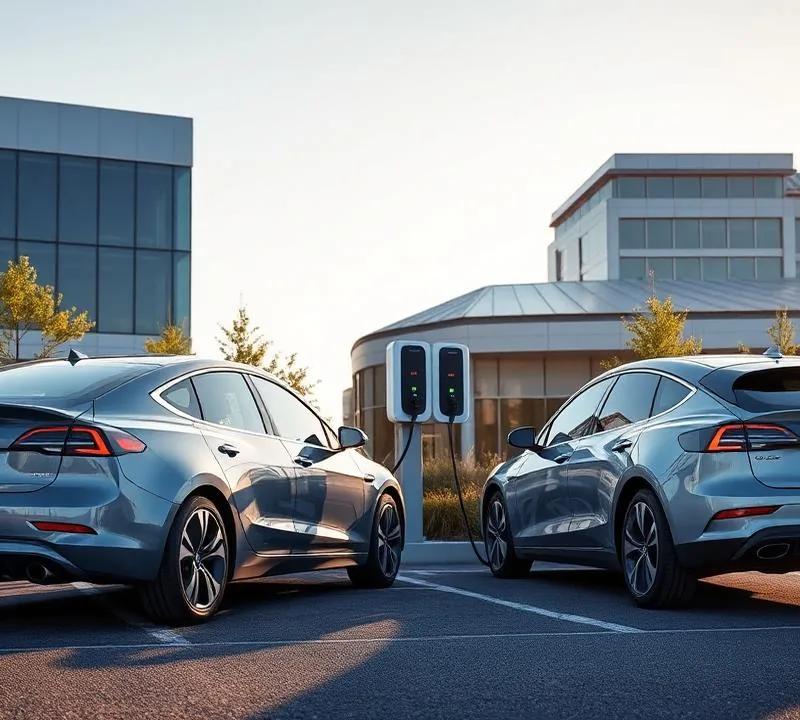
A company installing an EV charger rarely does it just for fleet convenience. More often it's a combination of three motivations: electrifying company vehicles, a perk for employees and customers, and a solid argument in ESG reporting. Here are concrete numbers and settlement mechanics, without marketing generalities.
Why a company needs a wallbox
Power sizing: 11/22 kW AC or DC 30-60 kW
For most offices, warehouses and employee car parks, 11 or 22 kW AC charging is enough — the car sits for several hours anyway, so a full charge in that time is realistic even at lower power, and AC infrastructure cost is several times lower than DC.
DC chargers (30-60 kW) make sense where vehicle turnover is fast: courier companies, taxis, service fleets, stations along transit routes where the driver charges in 20-40 minutes and returns to the road.
A practical rule when planning the number of stations: size AC points based on the number of electric vehicles in the fleet plus a 30-50% margin for fleet growth and guests, rather than on the total number of parking spaces — this avoids overinvesting from day one.
Grid connection, contracted power and DLM
Installing several 22 kW points can easily exceed a building's contracted power — this must be checked with the grid operator before buying equipment, since increasing connection capacity is a separate procedure and cost.
The solution is DLM (Dynamic Load Management) — a power management system that automatically distributes available power among charging points in real time so the connection limit is never exceeded. This allows more stations to be installed without an expensive connection upgrade, at the cost of slightly slower charging during peak hours.
DLM also offers an operational advantage: it lets you set charging priorities (e.g. company cars before employees' private ones, or vehicles with shorter dwell time before those staying all day), which meaningfully cuts waiting time for a free station once you have several charge points.
Synergy with photovoltaics
A company with a PV installation gains extra value: charging the fleet at midday, when solar output peaks, lets surplus energy be consumed on-site instead of being sold back to the grid at a low net-billing price. This meaningfully shortens the payback period of both the photovoltaic system and the chargers. Company car charging schedules should ideally match the peak PV production window — an EMS can do this automatically.
For larger fleets with an appropriately sized PV system, it's also worth considering an energy storage unit — it lets you shift midday surplus to afternoon charging for cars returning from routes once the sun is already low.
Settlement: cards, apps, reports
Practical implementation requires a user identification system:
It's also worth ensuring administrative access to the station management panel — remote visibility into charger status, session history and fault alerts significantly shortens IT or fleet team response time to issues.
Taxes and VAT — consult accounting only
Qualifying wallbox expenditure as a tax-deductible cost, depreciation rules for charging infrastructure, and VAT deduction (full or 50%, depending on vehicle use) are areas where interpretations vary and depend on the company's specific facts. We strongly recommend consulting the settlement structure with accounting or a tax advisor before implementation — this article does not replace that consultation.
Funding options for businesses
For companies modernizing their energy infrastructure, including RES installations accompanying chargers, the FENG eco-credit (BGK) is available, offering a 15-80% premium on eligible costs, aimed at SMEs, small mid-caps and mid-caps. The program covers thermal modernization and RES investments, which can help balance a charging station's energy demand. Note: the 4th call closed on 8 January 2026, with results expected in May 2026 — there is currently no open call. It's worth tracking BGK's schedule for the next round before starting an investment, as call windows tend to be short. EV chargers themselves are typically financed from own funds or leasing, regardless of grant availability.
Simple calculation: cost per 100 km
For a sample electric car consuming around 17 kWh/100 km:
| Energy source | Price per kWh | Cost per 100 km |
|---|---|---|
| Grid — company daytime tariff | approx. PLN 1.10/kWh | approx. PLN 18.70 |
| Grid — night tariff (if available) | approx. PLN 0.70/kWh | approx. PLN 11.90 |
| Own PV installation (generation cost) | approx. PLN 0.35-0.45/kWh | approx. PLN 6.00-7.70 |
The difference between grid charging and own midday PV is often more than half the cost per distance driven — for a fleet of several to a dozen or so vehicles, that makes a real difference in the fleet budget yearly. For a fleet of 10 vehicles averaging 20,000 km per year, the difference between the daytime tariff and own PV energy adds up to roughly PLN 20,000-25,000 in annual savings — a real argument in a budget discussion with management.
Bottom line
An EV charger at a company is an investment that pays off on several levels: operational (fleet), personal (perk) and reputational (ESG, customers). Key decisions are sizing power to actual vehicle turnover, securing connection capacity via DLM, and a transparent settlement system. Check our EV charger range matched to company scale and consider combining it with photovoltaics to lower the cost of every charged kWh.